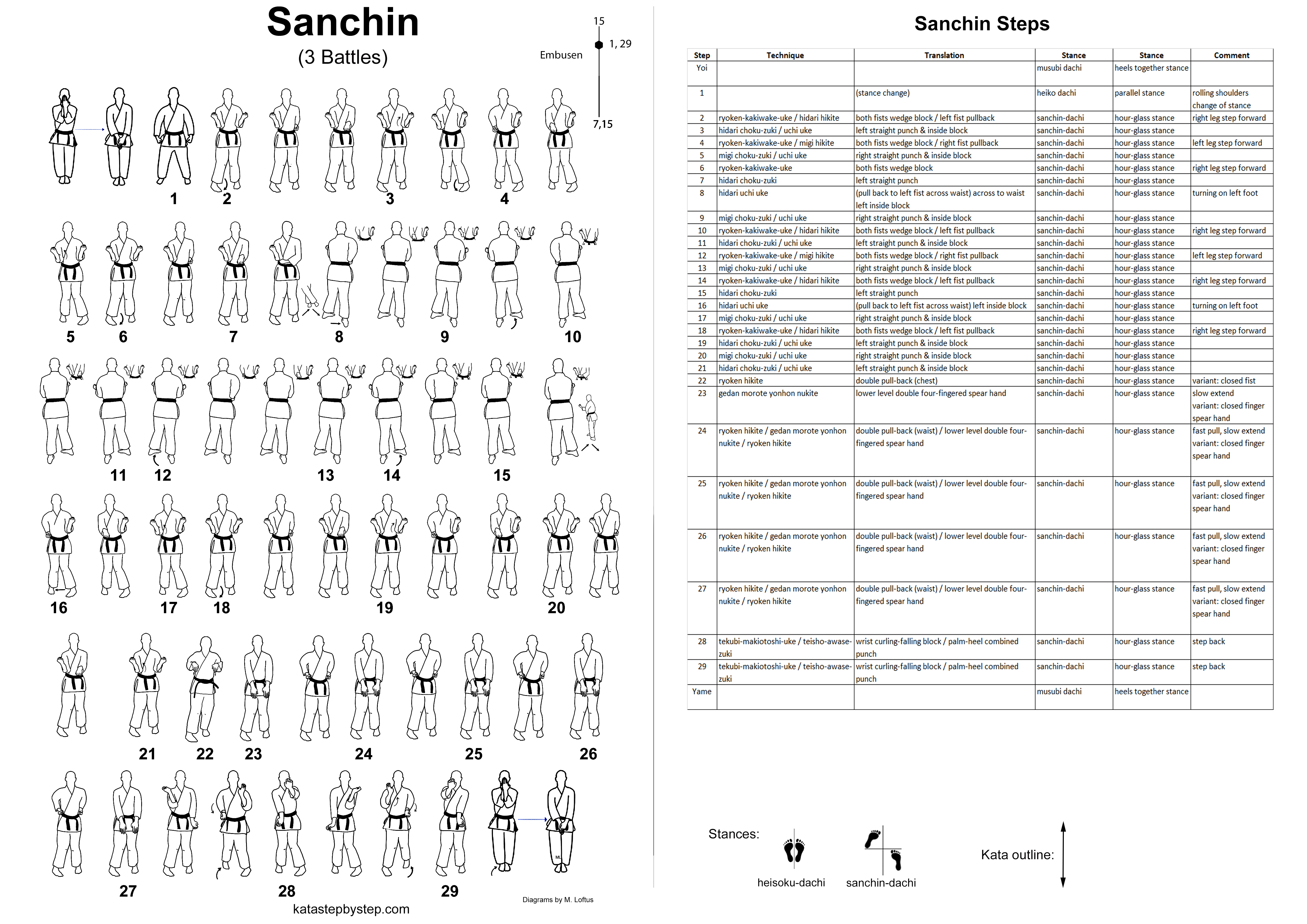
About This Kata
| Name | Sanchin [三戦] |
| Translation | Three Battles |
| Style | Goju-ryu |
| History | The name Sanchin means ‘Three Battles’, referring to the integration of mind, body, and spirit, or alternatively the coordination of breathing, posture, and movement. The kata likely originated in Fujian Province, China, during the 18th century as part of Southern Chinese martial arts traditions. Higaonna Kanryō learned it during his studies in Fuzhou, China, and passed it to students including Chōjun Miyagi and Kyoda Juhatsu. Miyagi later modified the kata to the closed-fist version used in Goju-ryu today. Some schools distinguish between ‘Miyagi Sanchin’ (closed fist) and ‘Higaonna Sanchin’ (open hand). Note that the Uechi-ryū version has a separate lineage, brought directly back from China by Kanbun Uechi. |
| Lineage | Chinese martial arts → Higaonna Kanryō (Naha-te) → Chōjun Miyagi (Gōjū-ryū) |
3 Battles (Goju Ryu Kata)