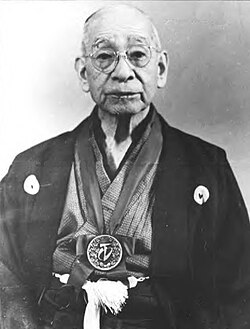
Chōshin Chibana, an esteemed Okinawan martial artist, was born on 5 June 1885, in the village of Shuri, Okinawa. He was the second son of Chibana Chohaku and his wife Nabi. The Chibana family had a distinguished lineage, tracing their ancestry to a branch of the Katsuren Court and to Choharu, the fifth son of King Shoshitsu (Tei). However, their noble titles and status were lost after the Meiji Emperor abolished the caste system in Japan, leading the family to turn to Awamori brewing for their livelihood.
In his youth, Chibana was described as having a notably gentle demeanour, both in movement and speech, to the point where his teacher, Itosu Ankō, would reportedly refer to him with his boyhood name and use gentle, almost “female” phrases, such as “And don’t hang around. Go straight home!” This anecdote suggests Chibana possessed a well-balanced character. Despite his slight build, measuring approximately 1.62m (5ft 3in) in height, his physical size belied a profound strength that stemmed from “martial power” or “spiritual strength,” originating from the tanden (lower abdomen).
Chibana began his formal martial arts training under Itosu Ankō in 1899, at the age of fifteen. He was accepted as a suitable student and remained Itosu’s sole teacher for thirteen years, continuing his training until he was 28. After Itosu’s passing at the age of 85, Chibana continued his practice independently for another five years before opening his first dojo. Yuchoku Higa, a later student of Chibana’s, deeply respected his teacher, adhering to the principle that “the teacher is more important than the style,” and remained Chibana’s disciple until his death.
Chōshin Chibana was a firm believer that karate, as a martial art, should not be taught merely as a sport or a form of physical exercise. He articulated that during practice, one should “forget everything and gather one’s spiritual energy together so that the head, eyes, hands and feet become united; the fingers and toes should become like spears so that a single kick or a single punch can kill”. He emphasised that achieving this demanding goal required “long, constant and careful practice,” and warned against the dangers of overdoing things. He also taught that practitioners should adapt and develop forms to suit their own body and temperament. His philosophy of doriyoku, or “total commitment in each movement,” aimed for “one technique, total destruction”. He was also known for his strict ethical standards, refusing to accept any prospective student with a “bad character”.
Chibana opened his first public dojo in the Tori-hori district when he was 34. Over the years, he relocated his dojo multiple times, including to the Kumoji district of Naha City, and in 1929, to Baron Nakijin’s courtyard in Gibo village, Shuri, renaming it “The Tode Kenkyu Sho (Tode Research Club)”. His teaching locations extended to both Naha and Shuri.
A significant contribution to karate nomenclature came in 1929 when Chibana became the first to officially name an Okinawan karate style with a Japanese ryu name, calling Itosu’s karate “Shorin-ryū” (小林流, “the small forest school”). This name later distinguished his lineage as the Kobayashi branch of Shorin-ryū karate-dō.
During the tumultuous period of World War II’s Battle of Okinawa, Chibana endured immense personal loss, losing his family, livelihood, dojo, and many students, narrowly escaping with his life. After the war, he returned to Shuri from Chinen Village and resumed teaching, opening new clubs across Naha and Shuri. From February 1954 to December 1958, he served as the Karate Advisor and Senior Instructor for the Shuri Police Precinct, also teaching Gōjū-ryū to the local police in Yonabaru. He collaborated with other masters like Chōtoku Kyan, performing demonstrations to promote the Shorin-ryū style.
Chibana played a pivotal role in the formalisation of Okinawan karate organisations. In May 1956, upon the formation of the Okinawa Karate Federation, he was elected as its first president. Two years later, he resigned from this role to form and preside over the Okinawa Shorin-ryū Karate-dō Association. By 1957, he received the esteemed title of Hanshi (High Master) from the Dai Nippon Butokukai (The Greater Japan Martial Virtue Association). His dedication was further recognised in 1960 with the Physical Culture Distinguished Services Award from the Okinawa Times newspaper, and in 1968, he was bestowed the Kunyonto Order of the Sacred Treasure, 4th Class, by the Emperor of Japan.
While Chibana primarily passed on Itosu’s style without alteration in its initial form, his student Shugoro Nakazato later incorporated Kihon and Fukyu kata into the Shorin-ryū curriculum. Chibana’s teachings emphasised “disguised” techniques within kata, such as transforming a standard middle block into a backfist. He instructed Sesan as a fundamental kata, practiced with dynamic tension akin to Gōjū-ryū‘s Sanchin, incorporating natural abdominal breathing synchronised with slow, powerful movements. He assured that this breathing method, mirroring natural human exertion (like stone masons breaking rocks), was safe as long as breath was not held during tension.
His “secret principles” for kata practice highlighted three key aspects: understanding kata to significantly enhance physical strength, recognising speed as essential in martial arts, and using kata practice to sharpen perception and develop powerful strikes. Even at 80 years old, Chibana humbly believed he still had “a long way to go” in his martial journey.
Chōshin Chibana’s notable students include:
- Ankichi Arakaki
- Yuchoku Higa
- Katsuya Miyahira
- Shūgorō Nakazato
- Nakama Chozo
- Eizo Shimabukuro
- Joki Uema
- Naonobu Ahagon
- Yoshihide Shinzato
- Jiro Shiroma
- Shinpan Shiroma
- Seiichi Iju
- Jesus Maninez
- Noel Smith
- Ernest Estrada
- Bob Hurten
- Franklin D.R. Hargrove
- Bus Martin
- Rod Lipka
- Lee Bates
- Emory Turner
- Shiyu Toma
- H. Gamani Soysa
- Noboyuki Iguchi
- Yusuke Horiyama
- Noriyasu Kinjo
In 1964, Chibana was diagnosed with terminal throat cancer. Despite his illness, he continued to teach, even undergoing radiation treatment in Tokyo in 1966, after which he briefly improved and resumed teaching with the assistance of his grandson, Nakazato Akira. His condition worsened by late 1968, and he passed away on 26 February 1969, at the age of 83, at Ohama Hospital. One of his last public appearances was in 1968, where he “danced to a delighted audience” during a demonstration.
Chōshin Chibana is remembered as the “Last Warrior of Shuri” and one of the most important pre-World War karate masters. As the sole surviving personal disciple of Itosu Anko in post-war Okinawa, he took it upon himself to honour his teacher’s legacy by leading the construction of a commemorative stone monument for Itosu in 1964. This selfless act not only brought him recognition but also played a crucial role in revitalising the Okinawan karate community and restoring a sense of pride devastated by the war. His lineage remains a significant branch of modern karate. He is widely regarded as one of the “superstars of Okinawan karate” and a key figure who made significant contributions to the development of modern karate-dō.
 Karate Kata Step By Step