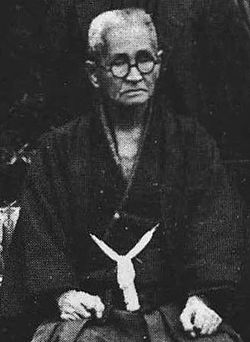
Chōtoku Kyan, an influential Okinawan karate master, was born in December 1870 in Gibo village, Shuri, Ryūkyū Kingdom. He was the third son of Kyan Chofu, who served as the steward to the last Ryukyuan King, Sho Tai. His family was descended from Shoen and was related to Shoshi-0, the fourth king of the old Ryukyu kingdom. Kyan Chofu, born in 1839, was the eldest son of Motonaga Chōyō and belonged to the royal Motobu Udun clan. He was adopted into the Kyan family at age 17 to become the head of his grandmother Manabe’s household, and he himself studied karate under Sōkon Matsumura. Later, Chōtoku was adopted back into the Motonaga family to continue his father’s lineage.
Kyan Chofu accompanied King Sho Tai into exile in Tokyo following the country’s annexation by Japan in 1879, and the young Chōtoku also journeyed to Tokyo. While in Tokyo, Kyan received a significant part of his academic education. The Kyan family continued to live a life of privilege in Japan, residing in a house provided by the king on the Sho family’s property. Chōtoku studied the Chinese classics (of Confucius) with Nakasu Mishima sensei at Nimatsu School in Fujimicho Town.
Chōtoku Kyan was described as small and thin, earning him the nickname Chan Mi-gwa (“Small-eyed Kyan”) due to a permanent squint. He was also reportedly asthmatic and often bedridden. Despite his physical limitations, his father encouraged him, stating that he could develop effective technique through diligent training and become “second to none”. Kyan was known for his competitive spirit and colourful personal life. However, some accounts suggest a more challenging personality, with Richard Kim describing his life as not easily lending itself to a heroic image, and Bruce D. Clayton suggesting Kyan had “deep emotional and mental problems”.
Chōtoku Kyan and his older brother Chohitsu began their karate training at the age of fifteen, after undergoing their “rights of manhood”. His father believed that a true Okinawan of high birth was infused with a martial spirit upon becoming a man. Kyan’s father arranged for him to undergo rigorous martial training, hoping to strengthen the youngster’s failing health. From the age of eight, Kyan received private lessons from many accomplished martial artists in Shuri and Tomari, learning various kata and weapons from at least a dozen sensei.
His notable teachers included:
- Sōkon Matsumura (1809–1901): Kyan began training under Matsumura, the karate instructor for the royal household, at age 16 for two years. Matsumura, then 80 years old, was described as tough, strong, healthy, and active with a physique better than much younger men.
- Sakuma Pechin.
- Itosu Ankō.
- Kōsaku Matsumora (1829–1898): From Matsumora, Kyan learned free-fighting and the kata Naihanchi.
- Kokan Oyadomari (1827–1905): From Oyadomari, Kyan learned Passai, Rohai, Wanshu, and Naifanchi.
- Maeda Pechin.
- Tokumine Pechin: Kyan learned the bo kata Tokumine no Kun from Tokumine’s landlord, after Tokumine himself had passed away.
Kyan firmly believed that inner-stability was essential for embracing karate throughout one’s life. He advised students to “Find an occupation suitable for your character, and one which will provide you with the opportunity to pursue karate”.
Kyan was renowned for his fighting skills and his willingness to accept challenge fights, similar to his contemporary Motobu Chōki. Due to his small size, he specialised in rapid sidestepping and vital-point strikes. His fighting accounts depict Shuri-te‘s commitment to single-blow victories, turning vital-point techniques into a lethal art, often targeting eyes and throat.
Several anecdotes highlight his character and fighting ability:
- At age 60, Kyan accepted a challenge from Shinzo Ishida, a judo 6th dan in Taipei. Kyan stripped to the waist to prevent throws, while Ishida maintained distance to avoid kicks. The two men stood staring at each other for some time, though the outcome is not detailed in the source.
- In another instance, Kyan scolded a large man named Matsuda for his aggressive behaviour. Matsuda challenged Kyan, claiming that Kyan, despite his physical talent, “knew nothing about real confrontations, as kata and actual fighting were completely different.” Matsuda offered to demonstrate his point, but the outcome of this encounter is also not specified.
- While his prowess was significant, some sources suggest his approach differed from others. Bruce D. Clayton remarked that Kyan was an “incredible fighter, perhaps the most formidable ever trained at Shuri,” but contrasted him with Itosu, who “was a grim and sober veteran of the Shuri Crucible,” implying Kyan was a “bitter amateur who didn’t understand the problem” of the time.
Despite his high birth, Kyan’s adult life was described as “miserably poverty-stricken”. Katsumi Murakami, citing Chōshin Chibana, stated that Kyan frequented the Tsuji brothels and enjoyed traveling. To finance these activities, he would sell piglets from his wife’s pig, deceiving her by keeping a portion of the earnings for himself. As a civilian, he dedicated his life to promoting karate, building his own house despite poverty, and teaching students in his yard. He also taught karate at the Kadena police station and the College of Agriculture and Forestry.
Kyan had a significant influence on the development of Shorin-ryū and related styles. He strongly emphasised kata training, and his interpretations of kata included movements that set them apart from those of other masters. His favourite kata were Passai, Chinto, and Kūsankū, which he modified to suit his small physique and evasive fighting methods, giving them a unique flavour. Kyan spent his life modifying Shuri kata, sometimes unconventionally, combining Chinese vital-point striking with the Shuri philosophy of ichigeki hissatsu (“one strike, sudden death”). He was among the Okinawan masters who participated in the 1936 meeting where the term “karate” was standardised.
Chōtoku Kyan taught a number of students who went on to become prominent karate masters themselves:
- Zenryo Shimabukuro (Chubu Shōrin-ryū): Shimabukuro studied with Kyan for over 10 years, from age 24 until 1944. He learned kata such as Naihanchi Shodan, Wanshu, Passai, Gōjūshiho, Chinto, Sesan, Kusanku, and Ananku. His first students were nephews and his eldest son, Zenpo, and he taught US Army paratroopers who introduced Kyan’s karate to the United States.
- Joen Nakazato (Shorinji-ryū): Nakazato studied under Kyan from ages 13 to 20 while attending the Okinawa Prefectural Agricultural School and Kadena Teachers’ Training College. He aimed to pass on Kyan’s style in its entirety, teaching Kyan’s nine unaltered kata, which are performed with powerful movements and contain “disguised” techniques.
- Tatsuo Shimabuku (Isshin-ryū): Shimabuku began training with Kyan around 1927 at Kyan’s home, studying until 1939. He learned Passai, Useishi (Gōjūshiho), Seisan, Naihanchi, Wansu, Chinto, Kusanku, Tokumine nu kun, and basic Sai. He also started his study of Ki (Chinkuchi) with Kyan.
- Ankichi Arakaki: He was a young disciple of Kyan. Nagamine studied under Arakaki first before training directly with Kyan, noting Arakaki’s modern, scientific teaching approach.
- Shōshin Nagamine (Matsubayashi-ryū): Nagamine learned karate from Kyan’s young disciples, Taro Shimabuku and Ankichi Arakaki. He also trained under Kodatsu Iha of Tomari-te.
- Tsuyoshi Chitose (Chitō-ryū)
- Kori Hisataka: Kudaka Kori, who headed a Shorinji-ryū dojo in Tokyo, was a childhood acquaintance of Nagamine and shared stories about Kyan.
- Taro Shimabuku.
Chōtoku Kyan passed away on 20 September 1945, at the age of 74. He survived the devastating Battle of Okinawa but died shortly after from fatigue and malnutrition in Ishikawa, in the north of the island. His last official demonstration occurred in Taipei in August 1930, where his sharp, powerful movements and indomitable spirit impressed the audience.
Kyan’s enduring legacy lies in his significant influence on the development of Shorin-ryū and related styles, and his contributions to the practical application of karate. While he and Gichin Funakoshi were considered diametrically opposite in character and karate style, their combined impact on the growth and direction of karate was immense. Motobu Choki provided evidence of karate as a practical self-defence tool, while Funakoshi cultivated it as an art form. Kyan’s contributions underscore the practical, fighting-oriented aspects that were crucial to the art’s early development.
 Karate Kata Step By Step