
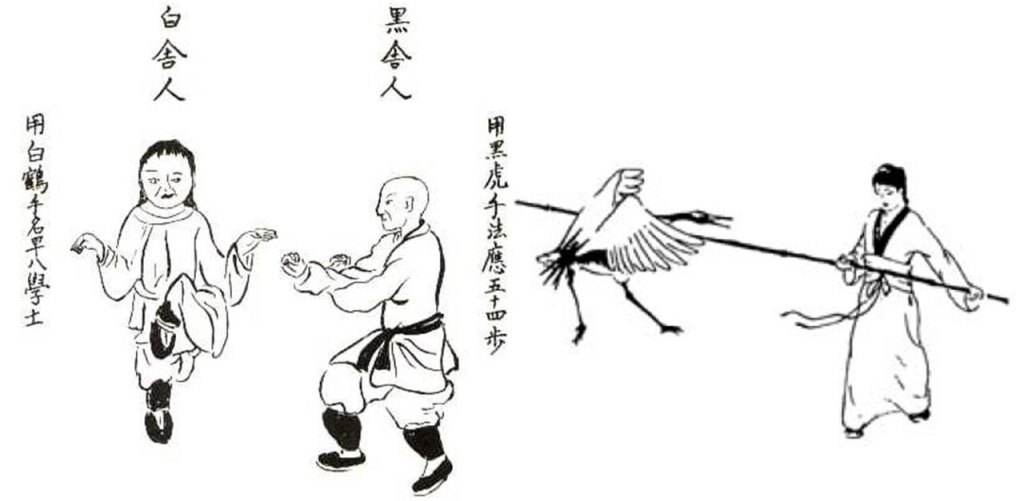
Fang Qīniáng (方七娘), also known as Fang Jiniang or Fang Quiniang, was a pivotal figure in the history of Chinese martial arts, specifically credited as the creator of the Fujian White Crane Gonfu (kung fu) style. Her innovations and philosophical insights profoundly influenced the development of various martial arts, including what would later become Okinawan karate.
Fang Qīniáng lived in the prefecture of Quanzhou in the Fujian province of China during the reign of the Jiajing Emperor (1521–1566) of the Ming Dynasty. This places her in the 16th century, though some sources incorrectly suggest a mid-18th-century birth.
Her path into martial arts was spurred by a deeply personal tragedy. Her father, Fang Zhonggong (also known as Fang Shiyu), was murdered by a gang. In response to this profound loss, Fang Qīniáng created the Fujian White Crane system, including the Hakutsuru (White Crane) kata, with the explicit goal of avenging her father’s death by destroying the responsible gang. She learned her initial martial system from her father, and after his murder, she was further trained by Lin Shixian, a Master of Black Crane and Eighteen Fist Monk Boxing, who assisted her in her quest for revenge.
Her unique style was significantly inspired by her observation of nature. It is said that she watched a crane fighting and subsequently incorporated these principles into the martial system she developed. This anecdote highlights the fluid and powerful, yet often deceptively soft, movements characteristic of White Crane.
Beyond its technical aspects, Fang Qīniáng’s style was imbued with profound philosophical dimensions. She articulated that “True power and wisdom come from within and are reflected without”. This core belief underpinned her teachings, emphasizing the internal development of the practitioner. She further stated that “This is the way to transcend ego-related distractions” and that “People who truly understand the fighting traditions are never arrogant or unscrupulous, and never use their skill unjustly”. These words, as quoted in the Bubishi, underscore a strong ethical foundation for her martial art, advocating humility and righteous application of skill.
Fang Qīniáng’s creation of the White Crane style had a significant impact on kata development, influencing many forms that became central to Okinawan karate:
- She is considered the creator of the White Crane style, which is the root of many later forms.
- It is considered not unlikely that she created the Niipaipo kata (also known as Nepai, or 28 beats), which is part of the southern Chinese White Crane style. However is generally thought to be an Arhat Fist form and some sources state that this was likely transmitted or popularised by Lín Dáchóng.
- The Hakutsuru kata, which contains elements of the Fujian White Crane system, was created by her.
- The sources indicate that many kata forms known today did not exist before her time. The existence of Wanshū and Kusanku kata, which have roots in the White Crane style, are seen as clear indicators of her period of influence.
Fang Qīniáng’s legacy is immense, particularly in linking Chinese martial arts to the origins of karate. Her style, Fujian White Crane, became a foundational influence for various karate traditions. Her position as the founder of the White Crane style is recognised in its genealogy, with her name engraved on the wall of a White Crane temple in Yong Chun, Fujian.
Her emphasis on internal power, ethical conduct, and the integration of natural observation into martial technique provided a rich theoretical and practical framework that resonated through subsequent generations of martial artists. The persistence of kata attributed to or influenced by her in modern karate styles, such as Wanshū (known as Empi in Shotokan) and Niipaipo, serves as a testament to her enduring impact as a martial arts innovator.
 Karate Kata Step By Step