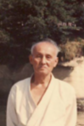
Hironori Ōtsuka (大塚 博紀) (1892–1982) was a highly significant Japanese martial artist, renowned as the founder of the Wadō-ryū (和道流) style of karate. His contributions were instrumental in integrating Okinawan karate with traditional Japanese martial arts, notably jujutsu, and shaping the modern competitive aspects of karate.
Ōtsuka was born on June 1, 1892, in Shimodate City, Ibaraki Prefecture, Japan, one of four children to Tokujiro Ōtsuka, a medical doctor. His martial arts journey began at a very young age:
- At five years old, he commenced training in jujutsu under his great-uncle, Chojiro Ebashi, a samurai.
- At the age of thirteen, he became a student of Tatsusaburo Nakayama in Shindō Yōshin-ryū jujutsu.
- His father took over his martial arts education in 1897.
- He continued his studies through school and university, eventually receiving the menkyo kaiden (certificate of mastery and license to teach) in Shindō Yōshin-ryū jujutsu from Nakayama on June 1, 1921. By 1928, at the age of thirty, he was awarded the title of grandmaster in jujutsu. It is a common misconception that he became the “4th grandmaster” of Shindō Yōshin-ryū, but the 3rd grandmaster, Tatsuo Matsuoka, actually outlived Ōtsuka by nearly eight years.
Ōtsuka initially worked as a clerk at the Kawasaki Bank because his father’s death prevented him from completing his studies and pursuing a full-time instructor career out of respect for his mother’s wishes. In 1927, he established a medical practice, specialising in treating martial arts training injuries. He was also known as a professional bonesetter. Later, he left his medical practice to dedicate himself entirely to martial arts. In 1944, he was appointed Japan’s Chief Karate Instructor.
While jujutsu was his primary art, Ōtsuka began training in karate in 1922 under Gichin Funakoshi, who had recently arrived in Japan. He quickly became an assistant instructor in Funakoshi’s Meishojuko dojo by 1928. His background in jujutsu, including kicking and striking techniques, meant he was already “on familiar ground” with Funakoshi’s teachings. He became proficient in the fifteen kata Funakoshi was teaching at the time.
Ōtsuka sought to broaden his karate knowledge beyond Funakoshi’s instruction, leading him to also train under:
- Motobu Chōki, who emphasised the necessity of free application and created two-person kumite (sparring).
- Kenwa Mabuni, founder of Shitō-ryū.
- He also studied kobudo around this period.
- He was also taught by Yasuhiro Konishi, founder of Shindō Jinen-ryū.
Ōtsuka developed philosophical disagreements with Funakoshi, and they eventually parted ways in the early 1930s. Funakoshi’s karate primarily emphasised kata, and he did not believe sparring was necessary for realistic training. In contrast, Ōtsuka believed there was a need for a “more dynamic and fluid type of karate”.
On April 1, 1934, Ōtsuka opened his own school in Tokyo, named the Dai Nippon Karate Shinko-Kai (All Japan Karate Promotion Association). His new style, Wadō-ryū, which means “way of peace,” was officially registered around 1939 and officially recognised as an independent style in 1934.
- The curriculum of Wadō-ryū was a fusion of Shotokan karate with Shindō Yōshin-ryū jujutsu. Most of the technical differences between Shotokan and Wadō-ryū are explained by the modifying influence of Shindō Yōshin-ryū.
- Wadō-ryū emphasises body-shifting and avoidance. Its objective is to cause pain and injury to the opponent while restricting any possible injury to the karateka. This knowledge of where and how to strike vital points is known as atemi-jutsu, for which Ōtsuka was noted for his exceptional expertise.
- After the ban on martial arts in Japan following World War II was lifted, Ōtsuka actively promoted karate through competitions in the 1950s.
Ōtsuka cultivated a number of significant students who went on to make their own marks in the martial arts world:
- Masaru Shintani.
- Tatsuo Suzuki (1928–2011), who later founded the Wadō Kokusai (Wadō International Karate-dō Federation) in 1989 due to dissatisfaction with the leadership of Ōtsuka’s son, Ōtsuka Jiro.
- Toru Arakawa.
- Hajime Takashima.
- His son, Ōtsuka Jiro, succeeded him and took the name Hironori Ōtsuka II.
Hironori Ōtsuka’s profound impact on karate was widely recognised throughout his lifetime and beyond.
- On April 29, 1966, Emperor Hirohito awarded Ōtsuka the Order of the Rising Sun, Fifth Class, in recognition of his significant contributions to karate.
- He authored two books on karate: Karate-dō, Volume 1 (1967), which focused on kata, and Karate-dō, Volume 2 (1970), which focused on kumite.
- On October 9, 1972, the Kokusai Budoin International Martial Arts Federation (IMAF Japan) bestowed upon him the title of Shodai Karate-dō Meijin Judan (first-generation karate master 10th dan). This marked the first time such an honour had been given to a karate practitioner.
- His students, Tatsuo Suzuki, Toru Arakawa, and Hajime Takashima, toured Europe and the United States in 1964, demonstrating Wadō-ryū karate and spreading its influence globally.
- Ōtsuka is counted among the “early progenitors of karate” and his contributions were pivotal in the transition of Okinawan karate to its modern, more dynamic form, especially by integrating sparring techniques. He is often contrasted with Gichin Funakoshi, who reportedly never received official titles and honours, suggesting Ōtsuka’s greater acceptance within the Japanese martial arts establishment of his time.
Hironori Ōtsuka passed away on January 29, 1982, leaving behind a transformative legacy that continues to influence karate practitioners worldwide.
 Karate Kata Step By Step