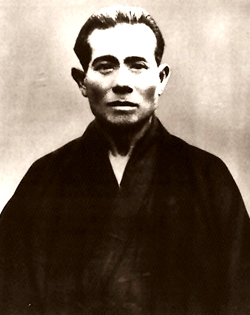
Kanbun Uechi, an influential Okinawan karate master, was born on 5 May 1877, in the Deikusaku section, growing up in the Takintō section of Izumi, a mountain farming village on the Motobu Peninsula of Okinawa. His family were daikon radish farmers. He was the eldest son of Kantoku Uechi, who belonged to the shizoku class and had moved from Shuri to Izumi to become a pioneer farmer.
In his youth, there are claims that Uechi studied bōjutsu and basic Chinese techniques from Motobu experts who had lived in China. However, a more recent Okinawan government-sanctioned publication states that no record exists of him learning “any kind of martial art” prior to his move to China. Uechi was reportedly mocked, nicknamed “Uechi Watabugwa” (“big belly” or “good-for-nothing Uechi”), due to a speech impediment and appearing “slow minded”. These experiences strengthened his resolve to learn Chinese martial arts and seek training elsewhere.
At the age of 20, in 1897, Uechi travelled to Fuzhou, China, where he began to learn a Kung Fu system he identified as “Pangai-noon” (or Pangainun). This style, which means “hard-soft,” was based on the principle of hard attacks and soft blocks. He studied under a Chinese master known as Zhou Zihe (called Shu Shiwa in Japanese, or Shu Shabu by Kanbun). However, research conducted by the Uechi Family and the local Wushu association in 1984 found that Zhou Zihe might not have been Uechi’s actual teacher, but possibly an assistant instructor, with Huzunquan (Fujian Tiger Boxing) lineage charts suggesting Zheng Xianji as his true teacher. More recent research provides no detailed answer on this matter.
From this training, Uechi learned three kata: Sanchin, Sesan, and Sanseryu. The Uechi Ryū Kihon claims that Kanbun Uechi never modified Zhou Zihe’s teachings and strictly passed on only what he learned. Conversely, a review of current Uechi-ryū practice with styles in Fuzhou suggests that Kanbun made his own modifications to create what he called “Pangai-noon”.
Uechi received a teaching licence from Zhou Zihe in 1904 and opened his own dojo in Nanjing in 1906. He continued periodic training under Zhou Zihe for three more years, totalling 13 years of study in China.
After his training in China, Uechi returned to Okinawa in 1909. He was determined never to teach martial arts again. One rumour suggests this decision stemmed from an incident in Nansoye, where one of his Chinese students reportedly killed a neighbour with an open-hand technique in a dispute over land irrigation.
Despite his initial refusal, word of his skill spread through figures like Go Kenki, a White Crane Kung Fu master and tea merchant who had met Uechi in Fuzhou and Nansoye and settled in Okinawa in 1912. Go Kenki would often tell interested customers about Uechi.
Due to the economic situation in Okinawa, Uechi, at the age of 47, left for Wakayama City, Japan, in 1924 to find employment. He worked as a security guard in a cotton spinning mill. In 1925, at the request of two Okinawan co-workers, he started teaching privately in the evenings after demonstrating self-defence techniques. By 1926, he agreed to teach a group of 30 men for 5 yen each per month, a significant income compared to his 15 yen monthly salary. He taught in small rooms in the company dormitory until 1932, when he opened a general store and the “Pangai-noon Karate Academy” to the public in Tebira, Wakayama Prefecture.
In 1934, Kenwa Mabuni, the founder of Shitō-ryū, interviewed Uechi for his article “The Story of Chinese Kempō”. It was Mabuni who suggested changing the style’s name to “Uechi-Ryū” (“style of Uechi”). The style was officially renamed in 1940 in Uechi’s honour.
Kanbun Uechi continued teaching in Wakayama until November 1946, when he turned his school over to his student, Ryuyu Tomoyose, and returned to Okinawa, settling on the island of Iejima. He met other prominent masters like Chōtoku Kyan, Kentsu Yabu, and Shigeru Nakamura during his time in Okinawa.
Kanbun Uechi passed away on 25 November 1948, at the age of 71, from kidney disease. There is an anecdote that he was told by a fortune teller he would live to be 88, which might have led him to not seek medical attention for his illness.
Kanbun Uechi is recognised as the founder of Uechi-Ryū, one of the primary Okinawan karate styles. His teachings, particularly the three kata (Sanchin, Sesan, Sanseryu), laid the foundation for the style. He was a firm believer in the power and strength gained from a well-balanced stance and firm posture, and promoted correct breathing, speed, and split-second timing, aiming to unite the mind and body in harmony.
After his death, his style was formalised by his eldest son, Kanei Uechi, and his senior students. Kanei was instrumental in Uechi-ryū’s global growth. He understood that modern students needed more structured learning than the original three kata. Therefore, Kanei, with other senior instructors, added five “bridging” kata between the original three: Seichin, Seiryu, and Kanchin, and two unspecified ones. He also added warm-up exercises (junbi undō) and standardised yakusoku kumite (prearranged partner exercises).
Kanbun Uechi’s style did not adhere to the Japanese Dan (rank) system during his lifetime. Out of respect, he is posthumously considered a 10th dan and referred to as “grandmaster”. His son, Kanei, described his father’s teaching manner as gentle, contrasting with other accounts that indicate he practiced body hardening techniques as a “street-side medicine hawker” to attract crowds, a more down-to-earth account preferred by some sources over more mythological histories.
 Karate Kata Step By Step