
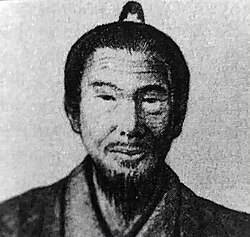
Kanga Sakugawa (佐久川 寛賀), often referred to as the “father” of Okinawan karate, holds a paramount place in the annals of karate history as one of its earliest pioneers. He was born into the noble class of Okinawa, though his exact birth and death dates vary in historical accounts, frequently cited as 1733–1815, but also appearing as 1782–1862 or 1786–1867. Similarly, his birthplace is recorded as the Yamakawa district of Shuri, Akata village in Shuri, or specifically between Torihori and Akata in Shuri. The challenge in pinpointing consistent facts about his early life is acknowledged by researchers, with Gichin Funakoshi likening the effort to “trying to catch hold of clouds”.
Sakugawa’s martial arts journey began around 1750, when he started training with an Okinawan martial artist named Pechin Takahara (高原 親雲上). Takahara, who himself had studied under the noted kobudo exponent Chatan Yara, imparted principles of dō such as compassion, humility, love, complete understanding of techniques, and seriousness in both practice and actual combat. After approximately six years with Takahara, Sakugawa was advised to continue his studies at Kumemura with a Chinese martial artist, Kūsankū (公相君).
Sakugawa studied with Kūsankū for about six years. Some sources also indicate that Kūsankū introduced Sakugawa to Kaizoku Ahman, a Muslim pirate shipwrecked on Okinawa, with whom Sakugawa trained for ten years. Notably, some prominent figures like Gichin Funakoshi and Shoshin Nagamine, however, contend that Sakugawa’s knowledge of Chinese martial arts came from his own travels and studies in China, rather than solely from Kūsankū in Okinawa. Some historians even suggest he may have died in Beijing while furthering his studies. Regardless of the exact pathway, it is universally agreed that his nickname “Tode” (唐手), meaning “Chinese hand,” was well-deserved, reflecting his profound understanding of Chinese martial arts.
As a member of Okinawa’s nobility, Sakugawa held the title of Pechin, and was later an official in Yaeyama by order of the Ryukyu Kingdom. He was also a scholar who diligently studied in China and was believed to be a teacher of kokugaku (ancient Japanese language, thought, and culture).
Sakugawa’s influence on karate is extensive. He is credited with several fundamental innovations that shaped the art. He was the first person to name the Okinawan unarmed fighting system “karate”. He is also recognised for establishing the dojo system of teaching and composing the first set of dojo kun (rules of behavior). These rules, which are still recited today, emphasise that the principles of conduct and attitude cultivated in training should extend into everyday life.
In terms of kata development, Sakugawa composed the kata Kūsankū in honour of his teacher, a form predominantly practiced in the Shuri-te lineage. The bō kata, Sakugawa no kun, is also attributed to him.
One of Sakugawa Kanga’s most distinguished students was Sōkon Matsumura (松村宗棍) (1797–1889). Despite Sakugawa’s initial reluctance to take on another student in his late seventies, he accepted the young Matsumura, who sought to become the greatest fist fighter in Okinawa. Matsumura trained under Sakugawa for approximately four years. Sakugawa also taught his son, Kangi Sakugawa, and possibly Bushi Tachimura, whose unique Shuri-te forms are still preserved today.
His enduring legacy lies in his pivotal role in proclaiming that the essence of bu (karate-dō) in Okinawa involved cultivating virtues, values, and principles, blending physical mastery with ethical conduct. His contributions continue to resonate throughout the history and practice of karate-dō.
 Karate Kata Step By Step