
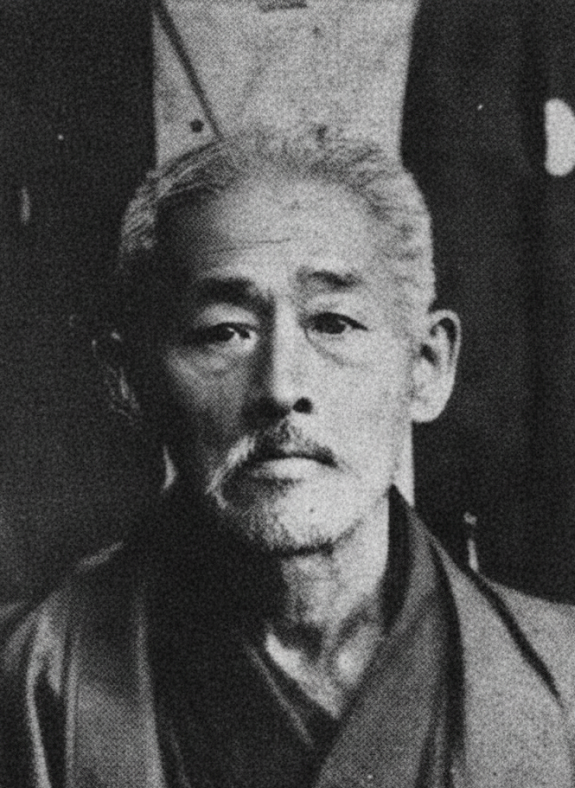
Higaonna Kanryō (東恩納 寛量), also sometimes known as Higashionna Kanryo, was a profoundly influential Okinawan martial artist, recognised as the founder of the Naha-te style and a pivotal figure in the development of modern Gōjū-ryū karate. He was born on 10 March 1853 in Nishimura, Naha, Ryūkyū Kingdom, and passed away in October 1915, at the age of 62 or 63.
Higaonna Kanryō was the fourth son of Kanyo Higaonna, who was the ninth-generation successor of the Shin family line. While his family was of the shi-zoku (noble) class, they were not prosperous. His father earned a living transporting firewood from the Kerama Islands in a small vessel. This work, which Kanryō began assisting with at around ten years old due to his younger brothers’ early deaths and his elder brother’s physical inability for manual labour, reportedly gave him strong legs and hips from steering the ship.
At the age of fourteen or fifteen, or about seventeen according to some accounts, Higaonna began studying martial arts. A popular legend states that in 1867, at the age of fourteen, his father was killed in a fight, and Kanryō resolved to travel to China to learn deadly martial arts to avenge his father’s death. However, a more likely explanation, according to one source, is that he left to avoid conscription by the Japanese army. Regardless of his motivation, he was greatly driven to learn martial arts and made swift progress.
Higaonna’s initial training in Okinawa was possibly in Okinawan ti basics. Some sources suggest he may have practiced under Mayaa Aragaki (Aragaki Seishō) as a teenager. Aragaki Seishō was an official interpreter at the Okinawan royal court and had reportedly studied in Fuzhou, China. In March 1873, Higaonna migrated to Fuzhou, China, possibly with a letter of introduction to Wai Xinxian from Aragaki.
In Fuzhou, Higaonna sought out a martial arts teacher. He was introduced to Ryū Ryū Ko (劉龍公), who owned a furniture-making shop. Some sources identify Ryū Ryū Ko as Xie Zhongxiang, founder of Whooping Crane Kung Fu. However, there is a conflict in the sources as Chōjun Miyagi visited Fuzhou in 1915 after Higaonna’s death (October 1915) to seek Ryū Ryū Ko, only to find he had died, whereas Xie Zhongxiang died in 1930, suggesting they were not the same person. Other names mentioned as his teachers in China include Wai Xinxian and Wan Shin Zan, or simply Ru Ru.
Higaonna Kanryō was accepted as a student by Ryū Ryū Ko after being judged as possessing the proper character to learn martial arts. As a condition, he was required to swear an oath of allegiance and promised to adhere to Ryū Ryū Ko’s principles and never misuse the knowledge. He spent about fourteen years in Fuzhou. During the day, he laboured diligently in his teacher’s workshop, making wicker baskets. In the evenings, he received martial arts instruction. His training included:
- Ashi-sabaki (stepping) and breathing techniques for four to five hours daily.
- Traditional training aids such as chiishi (weighted stick), nigiri game (gripping jars), tan (conditioning log), makiwara (striking post), kami (heavy earthen jars), and ishi-geta (stone clogs).
- Learning nine empty-hand kata: Sanchin, Saifa, Seiyunchin, Sanseiryu, Shisochin, Seipai, Seisan, Kururunfa, and Suparinpei (Pecchurin).
- Weapon forms such as daito (long sword), shuto (small sword), sai, and bo (staff). He also learned herbal medicine.
Higaonna trained so intensely that he often injured himself and even “passed blood with his urine”. Through his diligent study, his body underwent a complete transformation, and he became incredibly strong, looking “like a statue chiselled out of rock”. He eventually became Ryū Ryū Ko’s top student and an assistant teacher. Although he had no formal schooling in Okinawa, he diligently studied Confucianism and the tactics of Sun Tsu in connection with the chuan fa (Chinese boxing) he learned, believing that “physical training without spiritual study does not make genuine martial arts—the two are inseparable”. His favourite book was the Wubeizhi (Bubishi), particularly the section about the eight sayings of the fist.
Higaonna returned to Okinawa at either age 32 or 40. With Okinawa undergoing “Japanisation,” his limited education from China was of little use. He returned to his parents’ firewood business but reportedly became despondent and engaged in popular habits like drinking and womanising. However, a surge in karate’s popularity, partly due to the Japanese army’s interest, led him to take on students.
He began teaching the sons of wealthy Naha families in his parents’ courtyard. Higaonna was known for his strict ethical standards, reputedly refusing to teach “ruffians” and expelling any student who showed “bad character traits”. His teaching style involved arduous practice, with the first three or four years often dedicated solely to Sanchin kata, which led many students to drop out due to boredom. He called his style Shōrei-ryū (Enlightened Spirit Style), but it became commonly known as Naha-te.
Higaonna also taught martial arts in two different ways, depending on the student type:
- At home, he taught Naha-te as a martial art whose ultimate goal was to be able to kill the opponent.
- At Naha Commercial High School, he taught karate as a form of physical, intellectual, and moral education.
He consistently cited passages from the Wubeizhi (Bubishi) and stressed that physical training without moral philosophy was not to-te. He also believed that “karate needs technique and karate needs a purpose,” and that “in the martial arts spiritual improvement is important; so remember that if anything in life blocks your way, turn aside and go around it”.
Among Higaonna’s most prominent students were:
- Chōjun Miyagi (1888-1953): The founder of Gōjū-ryū, who started training with Higaonna at age 14 or 15 and persevered for 15 years. Miyagi was deeply impressed by Higaonna and was treated like a son due to his dedication to research and training.
- Kyoda Juhatsu (1887-1968): Higaonna’s most senior student, founder of the To’on-ryū style.
- Kenwa Mabuni (1889-1952): Founder of Shitō-ryū, who studied under both Higaonna and Itosu Yasutsune.
- Koki Shiroma.
- Higa Seiko.
- Shiroma Shinpan (Gusukuma).
Higaonna Kanryō’s impact on karate was immense, primarily through the Naha-te style. He systematically taught the nine empty-hand kata he learned in China: Sanchin, Saifa, Seiyunchin, Sanseiryu, Shisochin, Seipai, Seisan, Kururunfa, and Suparinpei. His kata compilations heavily influenced Gōjū-ryū. He was renowned for his powerful Sanchin kata, with students noting that “the wooden floor would be hot from the gripping of his feet”.
His teachings emphasised the integration of gō-no (hard) and jū-no (soft) techniques into a single system. This “hard-soft” approach would later define the Gōjū-ryū style, named by Chōjun Miyagi based on Higaonna’s frequent references to a passage in the Bubishi. A journalist, impressed by Higaonna’s students performing Sanchin, composed a haiku: “A roll of thunder, seizing the first bolt of lightning with the empty hands”.
While he learned weapon kata in China, Higaonna did not teach them in Okinawa, and these weapon arts are considered forever lost. Higaonna Kanryō is regarded as one of the “superstars of Okinawan karate”. He is credited with breathing life back into the chuan fa tradition in Naha. His commitment to character development and teaching only those with noble dispositions ensured that the art maintained a strong ethical foundation. His influential students, particularly Chōjun Miyagi, Kenwa Mabuni, and Kyoda Juhatsu, built upon his foundation, leading to the development and global spread of major modern karate styles like Gōjū-ryū, Shitō-ryū, and To’on-ryū. His teachings continue to reach millions of karate practitioners in the twenty-first century. Miyazato Eiichi sums up the essence of Gōjū-ryū by stating that a student must: “Be mindful of your courtesy with humbleness, train yourself considering physical strength, study and contrive seriously, be calm in mind and swift in action, take care of yourself, live a plain and simple life, do not be too proud of yourself, and continue training with patience and humbleness”.
 Karate Kata Step By Step