
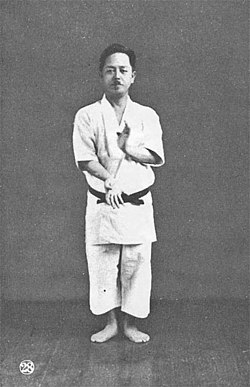
Kenwa Mabuni (摩文仁 賢和) was a profoundly influential Okinawan martial artist, best known as the founder of the Shitō-Ryū school of karate. Born on 14 November 1889, in Shuri, Okinawa, he was a 17th-generation descendant of the renowned Okinawan warrior, Uni Ufugusuku Kenyu, also known as “Oni” (“Demon”) Ufugushuku.
He was a frail child and his family sought to improve his frail and sickly constitution, leading him to begin martial arts training at a young age. At the age of thirteen in 1902, he commenced his instruction in Shuri-te under the tutelage of the legendary Itosu Ankō (1831-1915). Mabuni trained diligently with Itosu for several years, learning many kata from him. Itosu, a pivotal figure in modern karate development, was responsible for creating the Pinan kata. Mabuni remained Itosu’s student until the latter’s death.
In 1908, Mabuni’s close friend, Chōjun Miyagi, introduced him to Higaonna Kanryō (1853–1915). Higaonna was the leading proponent of Naha-te, the other major form of karate in the early 20th century. Mabuni trained with Higaonna, thus developing a deep understanding of both the Shuri-te (hard, linear techniques) and Naha-te (circular, close-range methods) styles. His style, Shitō-Ryū, fundamentally combines these two lineages.
Mabuni’s dedication to martial arts led him to seek instruction from a wide array of other teachers beyond Itosu and Higaonna. He learned from Aragaki Seishō, acquiring kata such as Unsu, Sōchin, and Niseishi, as well as Aragaki Sāi and Aragaki Bō kata. He also studied with Chōtoku Kyan, Tawada Shimboku, and Sueyoshi Jino. Through his Chinese friend, Wu Xiangui (Gō Kenki), an exponent of Fujian White Crane quanfa, Mabuni learned Hakutsuru Ken Kempō, from which kata like Nipaipo, Paipuren, and Hakutsuru were incorporated into Shitō-Ryū. Wu Xiangui’s teachings profoundly influenced the development of this lineage of karate. This extensive learning earned Mabuni a reputation for his “encyclopaedic knowledge of kata and their bunkai applications”. By the 1920s, he was considered the foremost authority on Okinawan kata and their history.
Mabuni served as an Okinawan policeman. In this role, he taught local law enforcement officers and, at Itosu’s request, began instructing in various grammar schools in Shuri and Naha.
Mabuni was one of the first Okinawan teachers to introduce karate to mainland Japan. He made several trips to Tokyo in 1917 and 1928 to popularise the art. In 1927, he met Jigoro Kano, the founder of judo, who was favourably impressed and encouraged Mabuni and Chōjun Miyagi to teach karate on the mainland. In 1928 or 1929, Mabuni relocated to Ōsaka, Japan, taking up permanent residence. He began teaching in various dōjō, including the Sei Shi Kan Dojo of Kokuba Kosei. Despite facing poverty in his early years on the mainland, he managed to open a small dōjō and publish pamphlets on his style by 1934.
Mabuni was instrumental in the establishment of the Karate Kenkyū-Kai (“Karate Research Association”) in 1918. This group, which included prominent Okinawan karateka like Chōjun Miyagi, Gichin Funakoshi, and Kyoda Juhatsu, met regularly to exchange theories and techniques. In 1925, Mabuni opened his garden at home for the association’s use as a meeting and training facility. This collaborative environment further broadened his knowledge of Shuri-te, Naha-te, and Tomari-te, a knowledge considered unequalled by his peers.
Mabuni officially founded his style, initially naming it Hankō-Ryū (“half-hard style”) to reflect its blend of hard and soft techniques. However, to honour his two primary teachers, Itosu and Higaonna, he soon changed the name to Shitō-Ryū. The name “Shitō” is derived by concatenating the first kanji of each of their names: “ito” (糸) from Itosu and “higa” (東) from Higaonna, which together (糸東) are pronounced “shitō”. This was his way of paying respect to his mentors.
The official recognition of martial arts by bodies like the Dai Nippon Butokukai was crucial for karate’s acceptance in Japan. Shitō-Ryū was officially registered with the Butokukai in 1939. Mabuni, along with other masters like Gichin Funakoshi and Chōjun Miyagi, was involved in the 1936 meeting where the term “karate” was standardised. He founded the precursor to the modern Shitōkai organisation in 1939.
Mabuni’s contribution to kata development was profound. He knew over ninety different kata, although he did not teach all of them publicly. His curriculum included fifty-three empty-hand kata and also integrated kobudō kata (bo, sai, and other Okinawan weapons), regarding karate and kobudō as a single art. He was likely the first to introduce Okinawan weapons arts to Japan. He also created at least ten kata himself between 1915 and 1940. For example, he developed new formal kata such as Aoyagi/Seiryu (Green Willow), with the assistance of Yasuhiro Konishi and Morihei Ueshiba, which were specifically designed for women’s self-defence.
Mabuni was a strong proponent of focusing deeply on a few kata rather than superficially learning many. He advocated for the principle of “hito kata sansen”, meaning a student should spend three years and three months learning a single kata and its bunkai (self-defence application) before moving to another. He believed that “If you practiced correctly, two or three kata are sufficient as ‘your’ kata. All others should be studied as an additional source of knowledge. Breadth, no matter how great, means little without depth”. He insisted that kata must be taught and practiced with a proper understanding of their bunkai, stating that “Kata movement is meant to be used in a real encounter”. His explanations of bunkai were remarkably detailed, covering striking, receiving, kicking, throwing, joint manipulation, and countering techniques.
Mabuni believed that karate was not just a system of physical techniques (taijutsu) but also rich in mental techniques (shinjutsu). He famously described karate-dō as “kunshi no ken” (“the fists of a gentleman”), implying that every karateka should strive to be a person of nobility, strong character, wisdom, and sophistication. His training included character development, emphasising values such as politeness, charity, respect, and grace, while warning against mistrust, laziness, pride, and envy. He stressed the importance of continuous self-improvement, encapsulated in the motto: “Try to improve, become better today than you were yesterday, and tomorrow become better than today”.
Regarding the principle “karate ni sente nashi” (“in karate, there is no first attack”), Mabuni offered a nuanced interpretation. He cautioned against rigid adherence that might preclude pre-emptive action when facing someone who disrupts peace or intends harm, asserting that it is reasonable to “forestall the enemy’s actions” in such cases. For him, the true meaning was to stop conflict and maintain peace.
Kenwa Mabuni died on 23 May 1952, at the age of 62. His passing led to a period of rivalry between his sons, Kenei Mabuni (1918–2015) and Kenzo Mabuni (1927–2005), both of whom claimed succession to Shitō-Ryū. Kenei, the elder son, was traditionally considered the rightful successor, but had not trained extensively in the art, while Kenzo had trained consistently with his father. Despite past rivalries, in recent years, both factions have acknowledged and respected each other’s legitimacy.
Mabuni’s legacy is profound. He transformed karate into a systematised martial way, making it accessible to a broader audience. His meticulous documentation and preservation of a vast number of kata, including his own creations and those from diverse lineages, safeguarded a significant part of Okinawa’s cultural heritage that might have otherwise been lost. His emphasis on character development, combined with a comprehensive understanding of both armed and unarmed combat, continues to influence Shitō-Ryū practitioners worldwide. Despite receiving little public fame or monetary rewards during his lifetime, he left a “great gift” to humanity, a style of karate that remains one of the four major styles of Japanese karate.
 Karate Kata Step By Step