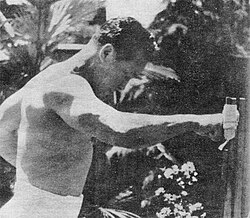
Masutatsu Ōyama (Mas Ōyama), originally Choi Yeong-eui (also known as Choi Bae-dal), was a Zainichi Korean karate master who established Kyokushin Karate, a style widely regarded as the first and most influential full-contact karate. Born on 27 July 1923 in Kintei, Korea (present-day Gimje, South Korea), Ōyama passed away on 26 April 1994, aged 70, due to lung cancer.
Ōyama’s early life saw him sent to Manchukuo, where he lived on his sister’s farm. At the age of nine, he began his martial arts journey studying Chinese martial arts under a Chinese farmer named Lee, whom he credited as his first teacher. His family belonged to the landed-gentry class, and his father, Choi Seung-hyun, was a notable composer of classical Chinese poetry. Much of what is known about his early life comes from his own accounts in his books.
After World War II ended in 1945, Ōyama moved to Tokyo, where he met his future wife, Chiyako, whose mother managed a university student dormitory. In 1946, he enrolled in Waseda University’s School of Education to pursue sports science.
Ōyama’s martial arts training was extensive and varied:
- Early Chinese Martial Arts: His initial instruction came from a Chinese farmer named Lee when he was nine years old.
- Shotokan Karate: Seeking top-tier instruction, he contacted the Shotokan dojo operated by Gigō Funakoshi. Ōyama trained under Gichin Funakoshi for two years in Tokyo, earning a 4th Dan black belt by the age of 24. He famously stated that “Master Funakoshi straightened me out,” and “He showed me the true meaning of karate”.
- Gōjū-ryū Karate: He studied Gōjū-ryū for several years under Nei-chu So (also spelled Sō Nei Chu), a Korean master and senior student of Chōjun Miyagi. Between 1946 and 1950, Ōyama also trained at Kanbukan, a dojo known for its Zainichi Korean members, where Nei-chu So was active and likely continued his Gōjū-ryū instruction.
- Other Disciplines: He also trained in boxing and judo. He is also listed as a student of Gogen Yamaguchi.
- Bushido and Solitary Training: In 1946, Ōyama met Japanese historical novelist Yoshikawa Eiji, author of Musashi, a work that apparently enlightened Ōyama to the true meaning of Bushido, the warrior code of feudal Japan. Yearning for perfection, Ōyama resolved to spend three years in harsh, self-imposed solitude to train his body and mind. After winning the 1947 Japanese National Martial Arts Championships, he again retreated to Mount Kiyosumi in Chiba Prefecture, training with “fanatical dedication” for another eighteen months, after which he felt he had “finally conquered himself”. His indefatigable self-promotion and the myths perpetuated by his followers and himself sometimes make it challenging to separate fact from embellishment regarding his life.
Ōyama initially aimed to become a military pilot, enrolling in aviation school and serving in the Imperial Japanese Army during World War II and it is said he nearly became a kamikaze pilot.
Ōyama’s formal creation of Kyokushin karate is generally dated to 1964, though the name itself had been in use for several years prior. He opened his own dojo, initially called Oyama Dojo (a form of Gōjū-ryū), in Tokyo in 1953. In 1956, he officially named his combat method Kyokushinkai, meaning “the ultimate truth style,” with a formal ceremony in 1957.
His dojo’s location evolved, moving from an empty lot to a ballet school in 1956, and eventually to the permanent Kyokushinkai hombu dojo in Tokyo in 1964. This same year, he formally established the International Karate Organisation Kyokushin Kaikan (IKO or IKOK) to unify the growing number of schools teaching his style.
Ōyama believed his style to be the most combat-oriented and effective of all martial arts. His teaching style was renowned for being tough, intense, hard-hitting, and practical, with grueling sessions where student injuries were common. He emphasised breaking objects like boards, tiles, or bricks to gauge offensive capability, famously stating that “ignoring ‘breaking practice is no more useful than a fruit tree that bears no fruit'”.
He built a formidable reputation as a courageous fighter, impressing observers with his combat skills. He was particularly known for his fights with bulls, having killed three with his punches and severed horns from several others with his “sword-hand” since 1951. This practice may have been influenced by an anecdote involving Kenwa Mabuni, where Ōyama, being Korean, might have sought to earn respect in nationalist Japan through similar displays of force.
Regarding kata, Ōyama’s style placed significant emphasis on them in its early stages. The Kyokushinkai kata are largely derived from Gōjū-ryū and Shotokan, reflecting his own training background. He also introduced Taikyoku kata forms into the Gōjū system as foundational training for beginner students.
Ōyama’s marketing prowess and leadership led to the rapid global expansion of Kyokushin, establishing branches in over 100 countries and attracting over 12 million registered members. He actively sent instructors worldwide to spread the style. He also pioneered full-contact karate tournaments, staging the first All-Japan Full Contact Karate Open Championships in 1969 and the World Full Contact Karate Open Championships every four years since 1975.
Ōyama’s legacy is immense, despite his controversial self-promotion. He earned the nickname “the Cat” from American GIs due to his gliding walk and flowing hair, and cultivated an aura reminiscent of the samurai era despite his small stature. The name “Ōyama,” meaning “Great Mountain,” is said to be typical of his chosen persona.
Late in his life, Ōyama suffered from osteoarthritis, but his dedication never wavered; he continued training and performing breaking demonstrations. He authored over 80 books in Japanese, some of which were translated into other languages, including the best-selling What is Karate. His colorful life and achievements have been immortalised in various media, including feature-length films and the popular manga series Karate Baka Ichidai. He also inspired iconic characters in pop culture, such as Ryu from Street Fighter and Takuma Sakazaki (a.k.a. “Mr. Karate”) from King of Fighters, solidifying his enduring impact beyond the martial arts world.
 Karate Kata Step By Step