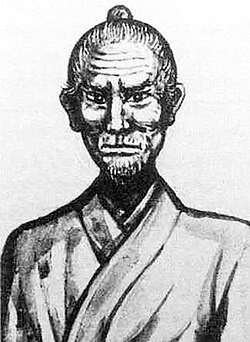
In the grand tapestry of Okinawan martial arts, few figures stand as tall and influential as Sōkon Matsumura (松村宗棍), often revered as the “Miyamoto Musashi of Okinawa”. He is a foundational pillar, deemed the central historical figure in the evolution of Shuri-style karate. While the precise dates of his life are subject to historical variations, with some sources citing 1809–1901 or 1798–1890, the family plaque at his tomb definitively records his birth in 1809 and his death in 1899, making him approximately 90 years old at his passing.
Matsumura’s early life laid the groundwork for his extraordinary career. He was born into a well-known noble family (shizoku) in Yamakawa village, Shuri, Okinawa. Beyond his martial inclinations, he was a gifted scholar and a renowned calligrapher, having diligently studied and embraced Confucianism. From a young age, he immersed himself in the basics of ti (hand), demonstrating an early passion for martial arts.
His martial education was extensive and varied. Matsumura began his formal training under Kanga Sakugawa. Though Sakugawa, in his late seventies, was initially hesitant to take on the young Matsumura, who had a reputation as a “troublemaker,” he honoured a promise to Matsumura’s father, Kaiyo Sōfuku, and accepted him. Matsumura devoted five years to studying under Sakugawa, a period that historians consider a seminal moment in the history of karate. His studies extended beyond Okinawa; he travelled to China, where his karate was profoundly influenced by Chinese martial traditions. He trained in chuan fa/quanfa and is believed to have learned from Chinese military attaches such as Iwah and Ason. Matsumura also journeyed to Satsuma in Japan, where he mastered Jigen-ryū swordsmanship under Yashichiro Ijuin, even earning a menkyo kaiden, a certificate signifying absolute mastery, from that school.
As a member of Okinawa’s nobility, Matsumura’s occupation was deeply intertwined with the royal court. In 1836, he was recruited into the service of the Shō family, the ruling royal family of the Ryūkyū Kingdom, receiving the prestigious gentry rank of Shikudon (Chikudun Pechin). For approximately 50 years, until 1879, Matsumura served as the chief martial arts instructor and bodyguard for three successive Okinawan kings: Shō Kō, Shō Iku, and Shō Tai. He also undertook diplomatic missions as a government envoy, traveling to Fuzhou, China, and Satsuma, Japan. Following the abdication of the king and the dissolution of the kingdom in 1879, Matsumura retired from public service, choosing a reclusive life dedicated to the continued development and teaching of karate-dō.
Matsumura’s character was as formidable as his martial skill. He was described as having a “terrifying presence” and was famously never defeated in a duel, despite engaging in many. His student, Itosu Ankō, recalled Matsumura as being “blindingly fast and deceptively strong”. He was a “driven man” who pursued martial arts with “fanatical devotion”. By age 14, he aimed to be the kingdom’s greatest fist fighter, a goal he achieved by 25. Anecdotes from his life reflect his cunning and power. One widely recounted story tells of a bullfighting contest where Matsumura ingeniously devised a strategy to defeat a bull. He secretly visited the bull for over a week, repeatedly banging it on the forehead with a heavy stick until it was subdued. Though some, like Shoshin Nagamine, characterised this as a “brutish story,” it cemented his fearsome reputation. His personal life also held unique aspects, such as his courtship with his accomplished wife, Tsuru, whom he viewed as the ideal woman, demonstrating his resolve to seek spiritual enlightenment through martial arts and poverty.
Matsumura’s impact on karate was nothing short of revolutionary. He is recognised as a “prime mover” in the development of the “linear power technique”. It is widely believed that linear karate, as we know it, did not exist before him, and he is credited with developing or inventing most of the high-impact techniques used in modern Shotokan karate. His contributions were not merely physical; he was a profound philosopher who championed the principle of bun bu ryo do – balancing physical training with metaphysical study. He famously proclaimed that the essence of bu (karate-dō) in Okinawa involved “cultivating virtues, values, and principles”. This holistic approach is encapsulated in the saying “shingitai ichinyo” (spirit and technique are one). His makimono, an ancient scroll containing his precepts, is considered the oldest document in Okinawan karate-dō and outlines his “Seven Virtues of Bu,” which served as guidelines for the kings and promoted peace in the Ryukyu Kingdom. His teachings became the bedrock of what is known as Shuri-te, and he is unequivocally regarded as the progenitor of many contemporary karate styles, including Shōrin-ryū, Shotokan, and Shitō-ryū. Indeed, “all modern styles of karate that evolved from the Shuri-te lineage can be traced back to the teachings of Bushi Matsumura”.
In terms of kata development, Matsumura’s influence is extensive. He is credited as the original author (or at least documenter) of foundational kata such as Kūsankū, Passai/Bassai, and Gankaku/Chinto. The bō kata, Sakugawa no kun, is also attributed to him. His kata eventually formed the very core of Shotokan. He was also a master of kobudo (ancient weaponry), renowned for his skill with the bō staff, the sai, and the ekubo (oar), for which he created specific kata.
Matsumura’s most distinguished students include Itosu Anko (1831–1915) and Ankō Azato (1827–1906), both of whom Funakoshi studied under and who were pivotal in the art’s subsequent development. Azato was considered “the greatest karate expert of his time”. Other notable students included Motobu Chōyū (1865-1929) and Motobu Chōki (1870-1944). Motobu Chōki, in particular, unequivocally stated that Matsumura was “the greatest martial artist who instructed” him. Matsumura’s grandson, Matsumura Nabe (1860–1930), and other significant figures like Kentsu Yabu (1866-1937), Hanashiro Chomo (1869-1945), Chōtoku Kyan (1870-1945), and Gichin Funakoshi (1868-1957) also benefited from his teachings, directly or indirectly.
The legacy of Bushi Matsumura is immense and enduring. He is undeniably regarded as one of the most important historical figures in the annals of karate-dō. His profound impact stemmed from his unwavering commitment to blending physical prowess with ethical conduct, emphasizing bun bu ryo do – unified and balanced development of both intellectual/artistic pursuits and martial skills. His teachings and the knowledge he cultivated have trickled down into nearly every branch of modern karate, influencing countless practitioners and shaping the art as we know it today. Even the name “Shotokan” indirectly honours him, as the “Shoto” (松涛) in Gichin Funakoshi‘s pen name shares the same kanji character as “Matsu” (松) in Matsumura’s name. His makimono, oldest document in the annals of Okinawan karate-do, remains an invaluable message for anyone seeking to grasp the true essence of karate-dō, ensuring his contributions will live on forever.
 Karate Kata Step By Step