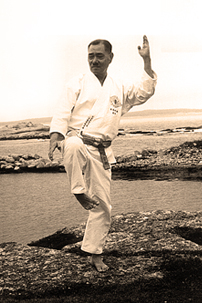
Chitō-ryū is a distinct style of Okinawan karate, founded in the mid-20th century by Dr. Tsuyoshi Chitose, blending elements from the traditional Shuri-te, Naha-te, and Tomari-te lineages of Okinawa. Its name, meaning “1,000 year old Chinese style,” reflects its deep roots in Chinese martial arts and its founder’s extensive research into karate’s origins.
Founding and Origins
Chitō-ryū was officially founded in 1946 by Dr. Tsuyoshi Chitose. The name “Chitō-ryū” translates as “chi” (千) for 1,000, “tō” (唐) for China (referring to the Tang dynasty), and “ryū” (流) for style or school, collectively meaning “1,000 year old Chinese style”.
The style is generally classified as a Japanese karate style because Dr. Chitose primarily formulated and founded it while living in Kumamoto, Japan. However, many modern practitioners advocate for its categorisation as an Okinawan style due to its foundational techniques and principles being firmly rooted in traditional Okinawan Tōde (唐手).
Dr. Tsuyoshi Chitose (千歳 强直, Tsuyoshi Chitose) was born on 18 October 1898, in Kumochi, Naha City, Okinawa Prefecture. His Okinawan name was Chinen Gua. His martial arts lineage was notable, as his maternal grandfather was Sōkon Matsumura, a highly influential figure in the Shuri-te tradition.
From a young age, Chitose grew up studying karate (唐手, Tang hand) and kobudō in Okinawa. In 1921, he moved to mainland Japan to pursue studies in medicine.
Influences and Training: Dr. Chitose’s martial arts education was comprehensive, drawing from several prominent Okinawan masters:
- He began training in Tōte under Aragaki Seishō in 1905 at the age of seven, continuing until 1913/1914. During this period, he notably learned the Sanchin kata from Aragaki for seven years before being taught any other kata, indicating its fundamental importance in his training. Other kata attributed to his training with Aragaki Seishō include Unshu, Seisan, Niseishi, and possibly Shihōhai. Aragaki Seishō was also a renowned weapons master, teaching kata for bo and sai, such as Aragaki-no-kun, Aragaki-no-sai, and Sesoku-no-kun.
- Higaonna Kanryō, a major influence on the Gōjū-ryū style, was also one of Dr. Chitose’s primary teachers.
- He also learned Shihōhai from Hanashiro Chōmo at Sōgen-ji. (There is some dispute regarding the origin of Shihōhai in Chitō-ryū, with sources attributing it to both Aragaki Seishō and Hanashiro Chōmo).
- Dr. Chitose developed Chitō-ryū by combining the strength techniques he learned from Shuri-te (which includes influences from Shōrin-ryū and Shōrei-ryū) with those of Naha-te. The influence of Tomari-te is also present in Chitō-ryū, though it is less evident than that of Shuri-te and Naha-te.
Official Recognition and Achievements: Dr. Chitose achieved high recognition within the martial arts community:
- In 1958, he was awarded the rank of Judan.
- In 1968, he received the title of Hanshi from the Zen Okinawa Karate Kobudo Rengo Kai (All Okinawa Union of Karate-dō and Kobu-do).
- He is the author of the seminal textbook “Kempō Karate-dō — Universal Art of Self-Defence”.
- In 1934, Kenwa Mabuni (founder of Shitō-ryū) interviewed Dr. Chitose for an article titled “The Story of Chinese Kempō” in the Karate Research journal.
Style Characteristics and Differences
Chitō-ryū is characterised by very concise kata that reflect the unique and diverse training experiences of its founder. A key distinguishing feature is that many Chitō-ryū kata, while bearing the same names as other traditional Okinawan kata, are typically very different from the original or standard version. Some may share only one or two signature moves that relate it to the original while others are completely different except in name.
The style’s higher-level kata show a decisively strong Chinese influence. Specific technical characteristics of Chitō-ryū include:
- An emphasis on “shime” (tightening or contraction).
- The use of “shibori” (twisting or wringing action).
- Rapid rotational movements.
- Frequent use of tai sabaki (movement off the line of attack) at advanced levels.
An important exception to the general difference in kata performance is that Chitō-ryū versions of Seisan, Bassai, and Chintō are “nearly identical to the original Shōrin-ryū forms as taught by Chōtoku Kyan“.
Growth and International Spread
Chitō-ryū has seen significant growth, particularly in Canada. The style’s founder, Dr. Tsuyoshi Chitose, first visited Canada in 1967, accompanied by his protégé Mamoru Yamamoto (who later founded Yōshūkai Karate-dō). This trip was organised by Masami Tsuruoka, who is recognised as the father of Canadian karate. During this visit, Dr. Chitose presided over events at the Canadian National Karate Tournament in Toronto and conducted clinics at dojo across Canada. The current head of the Chitō-ryū style, Dr. Chitose’s son, has continued this practice, conducting clinics in Canada approximately every other year. Consequently, Chitō-ryū is a popular mainstream karate style in Canada, with approximately 60 Chitō-ryū dojo across 8 of Canada’s 10 provinces.
Katas of Chitō-ryū
Chitō-ryū incorporates a range of kata, some of which are unique to the style or show particular interpretations:
Empty-Hand Katas:
- Sanchin: Learned by Dr. Chitose from Aragaki Seishō, and notably practiced for seven years before any other kata. This kata has foundations in the White Crane style and is sometimes connected to Bodidharma.
- Unshu: Attributed to Dr. Chitose’s training with Aragaki Seishō. This is a fluid and complex kata, showing strong Chinese martial arts influence.
- Seisan: Attributed to Dr. Chitose’s training with Aragaki Seishō. The Chitō-ryū version is nearly identical to the original Shōrin-ryū forms as taught by Chōtoku Kyan. This kata literally means ’13’ and has various interpretations in different styles such as ’13 Hands’ or ’13 Techniques’. It has roots in Shuri-te, Naha-te, and Tomari-te streams. Isshin-ryū teaches Seisan as its first kata, with vertical fists and incorporating tension/breathing techniques similar to Gōjū-ryū.
- Niseishi: Attributed to Dr. Chitose’s training with Aragaki Seishō.
- Shihōhai (四方拝, “four-direction salute”): This kata is peculiar to Chitō-ryū. Its origin is disputed, with some sources claiming Dr. Chitose learned it from Aragaki Seishō, and others stating he learned it from Hanashiro Chōmo at Sōgen-ji. Historically, it was used in royal ceremonies of the Ryūkyū Kingdom, with the “salutation to all four sides” being of great significance. Some Chitō-ryū groups practice an extended “dai” (大) version that includes additional techniques.
- Bassai: The Chitō-ryū version is nearly identical to the original Shōrin-ryū forms as taught by Chōtoku Kyan. Passai (also Bassai) was one of the three most practiced kata in Okinawa, along with Naihanchi and Kūsankū, and has many variations depending on the school.
- Chintō: The Chitō-ryū version is nearly identical to the original Shōrin-ryū forms as taught by Chōtoku Kyan. Chintō was known in early Tomari-te and Shuri-te schools. Gichin Funakoshi renamed Chintō to Gankaku (“crane on a rock”) in Shotokan, possibly to avoid anti-Chinese sentiment, and modified its movements and stance.
- Hoen: A fluid and complex kata, showing strong Chinese martial arts influence.
Weapons Katas: The sources mention that Aragaki Seishō, one of Dr. Chitose’s primary teachers, was a famous weapons master, teaching kata such as Aragaki-no-kun (bo kata), Aragaki-no-sai, and Sesoku-no-kun. It is reasonable to infer that these kobudō forms would have influenced the style, though explicit Chitō-ryū kobudō kata lists are not provided in these sources.
Branches and Official Organisations
Several organisations and branches are associated with Chitō-ryū:
- The Chitō-ryū Sohonbu Office.
- The International Chito-ryū Karate-dō Federation is a parent organisation from which some branches have emerged.
- Canadian Chito-ryū Karate-dō Association: This association experienced a rift with the Japanese parent organisation in 2008.
- International Chito Ryu Karate-dō Association ICKF Canada.
- Australia Chitokai Karate Association Inc.
- Ryūsei Karate-dō: This is a style derived from Chitō-ryū, founded in 1997 by Ken Sakamoto after he left the International Chito-ryū Karate-dō Federation.
Legacy
Dr. Tsuyoshi Chitose‘s legacy is significant for his comprehensive approach to karate, combining the major Okinawan martial arts lineages into a single, unified curriculum. His style is recognised globally, with strong communities like those in Canada. His dedication to documenting his teachings through works like “Kempō Karate-dō — Universal Art of Self-Defence” ensures the preservation of his extensive knowledge for future generations. His official recognition as a Judan and Hanshi by the Zen Okinawa Karate Kobudo Rengo Kai highlights his profound impact and respected position within the broader Okinawan martial arts world. The continuous practice and adaptation of Chitō-ryū, even through organisational shifts and derivative styles like Ryūsei Karate-dō, demonstrate its enduring influence and the ongoing evolution of its teachings.
 Karate Kata Step By Step